


We know how to build a green economy. It’s not a secret, and it’s not future technology.
We know how to build affordable green power and storage. We know how to create reliable electric vehicles and EV infrastructure. We know how to create energy efficient homes, mines, factories and offices.
And we know we can do all of that in a way that creates a more efficient, more comfortable, more affordable economy than the one we currently have.
What keeps us locked into our current level of carbon emissions is, well, we already have all that old, higher-carbon stuff. If Canada didn’t exist and 40 million of us were dropped into this space and rebuilt what we have to today’s standards, it would be the greenest economy on Earth. It would also be the most productive and prosperous.
Environmental groups have been pointing this out for years. Cost for renewables plus storage is lower than conventional energy! Energy efficiency pays for itself! The market has spoken and green energy is two thirds of all energy investment!
Climate plans of yesterday needed to commercialize emerging technologies and help scale options that were not yet cost competitive, to make the future possible. They’ve done their work. Climate plans of today and tomorrow need to bring in investment to build, rebuild and retrofit our economy.
Because as much as it is true that investment makes our economy greener, the inverse is also true: if we do not invest in our economy, we will remain locked into high-carbon legacy infrastructure. Compliance-based measures will eventually hit their ceiling. And decarbonization efforts will become increasingly economically painful and increasingly offside with the public.
So the question for all good environmentalists becomes: how do we get capital into Canada at a scale never before seen?
THE CAPITAL QUESTION
Let’s be clear about the scope. We are not talking about a new government grant program funded by playing with tax margins. The replacement cost of the built economy in Canada in 2024 was about $8 trillion.
That kind of investment pool does not exist in Canada. Building the next economy requires global capital – capital that moves based on economic interest: calculated by rate of return and rate of risk.
Rate of return. The difference between a project going forward and not is not “does it generate positive return?”. The difference is: “does it generate more of a positive return than the other thing I can invest in?”. Competitive tax rates, green investment credits and tax treatments like the new productivity super-deduction make an investment more appealing by increasing rate of return.
Rate of risk. Investors do not just ask “how much money could this make?”. They also ask, “how confident am I that this outcome will actually happen, and what could go wrong along the way?”. Capital is attracted to regulatory and tax policy certainty. They want to know how long it will take to approve a wind farm. They want to know if they make an investment in carbon reduction that there will still be climate policy in five years.
We do not, however, want a race to the bottom, and there are many decisions that global investors have made at other times and in other jurisdictions that wouldn’t be acceptable to Canadians. Investor interests must ultimately align with Canada’s interests. Can the frameworks for investment we create further strengthen our environment? Our local economy? Our communities?
From there, we can find – and aggressively go after – common opportunity.
This, fundamentally, is the thesis: Canada gets the capital that greens our economy by being a stable, competitive investment environment. By being smart about the environment of grants, credits, industrial pricing and regulations. By understanding why investors build, and how we can align their interests to ours, creating a green economy in which prosperity is broadly shared.
CLIMATE COMPETITIVENESS
This is the heart of what Prime Minister Carney and Environment Minister Dabrusin have called climate competitiveness. Incentivizing low carbon, disincentivizing high carbon – and doing so in an investment friendly way that strengthens our future economy.
The plan starts with an overall environment conducive to green investment: competitive corporate tax rates and green investment tax credits.
From there, three key tools, present in both the recent federal budget and the Alberta-Canada MOU, are layered on:
Industrial pricing. This entrenches the polluter pays principle: carbon emissions are not good for the planet, and if you are industrial emitter, you will pay for it. Effective industrial carbon pricing becomes the main signal to markets: incentivizing carbon reduction technologies and discouraging carbon production.
Methane reduction. Methane is a potent greenhouse gas with a shorter lifecycle than CO2. Reducing methane emissions is also one of the lowest cost ways to reduce our emissions. Methane reduction is the low-hanging fruit – where industrial pricing is the system-wide way to push low- and no-emission investment, methane reduction is the targeted tool to see big reductions while building is underway.
Carbon capture. Tackling climate change will require undoing the damage we’ve done to the planet and offsetting hard-to-decarbonize sectors. Carbon capture becomes the signature technology that allows us to fundamentally change the emissions profile of entire sectors – notably the oil and gas sector. It also positions Canada as a leader on exportable technologies that will be in high global demand.
Those tools are approached with the following philosophy:
Simple is better. Where one or two tools can do the job of two or three tools, use fewer tools. Cap emissions to drive them down or price emissions to drive them down, but only cap and price emissions together when necessary.
Layering of tools can create uncertainty about future state and should generally be avoided, as it was when the proposed emissions cap was set aside if action occurs on Pathways carbon capture and effective industrial pricing is established.Durable is better. Regulatory uncertainty – particularly around the future state of industrial carbon pricing – puts a chill on green investment. Investors do not want to invest if they think a change in government could eliminate the entire framework that made the investment economical.
Carbon contracts for difference and long-term accords that cross political divide (e.g. between a Liberal government federally and a UCP government in Alberta) make climate action durable, hard to reverse, and bankable for investors.
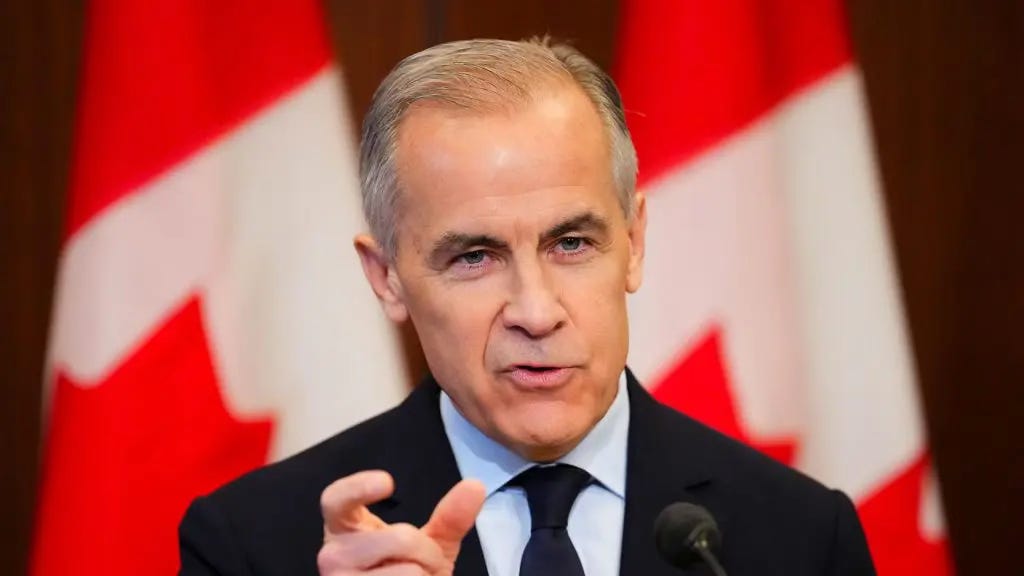
“It is important to note that our electricity grid currently emits a little under 50 megatonnes, while emissions from industry, transportation, and buildings are well over 500 megatonnes. By far the biggest prize is reducing emissions – affordably – through electrification, not pursuing absolute purity in generation. Aggressive electrification can reduce total emissions by up to five times current total electricity emissions.” – Mark Carney launching Electricity Strategy
Keep your eye on the big picture. The goal is to push back climate change. The goal is a net-zero economy by 2050. Getting there will require significant investment – particularly in power infrastructure and electrification.
To reach our goals, we can’t fixate on emissions from one sector at the expense of the emissions profile of the entire economy: the government can and must be willing to trade 1 MT of emissions in electricity production to reduce 2 MT of emissions elsewhere.
Outcomes are what matters. Despite a $90/tonne “headline price” for carbon emissions, Alberta carbon credits were trading at an effective price of around $20 last year. New ways - floor prices and strengthened contracts for differences – move the effective price way up even as the headline price comes down.
And finally, we live in a democracy. Climate action needs to be broadly supported, or else it won’t exist at all.
A year ago Conservative leader Pierre Poilievre stated his goal of eliminating industrial carbon pricing altogether. Arguments about whether a $130 effective price is equivalent to the previous $190 headline price, or about whether 2035 or 2040 is the appropriate time to hit that target on our path to net zero in 2050 look a bit absurd in that light.
A climate agenda based on strong growth is a climate agenda you are far more likely to be able to build consensus around, and far more likely to survive government changes driven by the ballot box.
If you care about living in both a democracy and a country that acts on the environment, how popular climate action is matters.
GROWTH AND PROSPERITY
There was never one way to meet our climate goals1. Yesterday, we were on a more compliance-based path. Today, we are on one based on a simple idea: that we know how to do it better now – and given the opportunity (and money to do so), we will.
Rebuilding the Canadian economy has other benefits too. It allows us to shift trade and be less reliant on the United States. It lets us rectify a historic wrong by partnering with First Nations, Metis and Inuit peoples in a way that previous generations did not. It lets us grow opportunities in every corner of this nation, and in doing so make sure we are building a strong Canada for all.
Combatting climate change is a moral imperative. The energy transition is a moral imperative. It’s a transition we need to do as fast as possible, both for our planet and to make sure Canada does not get left behind in a world that – as has already been noted – is already spending two out of every three dollars on energy on green energy.
It will take trillions in investment to build the next economy. It’s daunting. But done right, it’s exciting. It’s also how you make sure in a democracy there is a broad consensus for action. As we’ve seen in the Alberta-Canada MOU, you can build a non-partisan consensus around strong environmental action when it’s paired with growth.
The path to net zero runs through construction sites, transmission lines, factories, retrofits, and investment decisions. It runs through growth.
It’s time to build.
Experiences around the world show us ours was arguably not even the most effective . Take the example of the United States. Emissions declined under Biden’s carbon-tax-free Inflation Reduction Act about what they did in Canada – or even better – over the 2021-2024 timeframe.
Thanks for the view into the current government policy.
As I read through this piece, I think the part that deserves more attention would be measures that make it easier for consumers to switch to green options. EV, heat pump, better windows and insulation, solar panels and batteries. That interest free loan program has expired under this government.
When you mention risk and return at the corporate and foreign investment levels, it seems to me that your government approach is that we, as Canadian taxpayers, need to publicly subsidize to reduce risk and guarantee return for foreign investors and foreign and domestic firms. If that's the case, is the mechanism for taxpayers going to be public ownership of parts of these assets? Or will we have to rely on trickle down economics for our return? I fear it's the latter.
Our track record, if we are being honest, is an approach where we publicly talk about shared cost and shared risk, but then we look around and suddenly we have abandoned wells and oil sands tailing ponds that will need to be cleaned up on the public dime. So that's where the talk of polluter pay sounds great, but are our governments at both the provincial and federal level, willing to enforce that principle? History tells us no. Is it possible this government will be different? Maybe. But I'm skeptical.
If the Liberals want to boost the economy, benefit citizens, and decrease carbon emissions, I'd strongly advocate for supporting increasing energy efficiency. Bring back support (grants, loans, and tax benefits) for housing retrofits. Help small companies switch to practices that keep them functional with lower energy costs.
This additional (!) pipeline will benefit only a select few - already wealthy people will increase their wealth at the expense of the rest of the world. It will further endanger land (Indigenous and rural people in particular will suffer) and we will keep careening towards ever more extreme climate tipping points. Sure, we'll skim off some profits for our governments and a few employees, but the net effect is harmful.
Helping people lower their energy costs would help lift some out of poverty or near-poverty. Efficiency will lower the demand for carbon-producing energy sources - not only in net emissions, but in maintaining inefficient infrastructure. We'd also feel like the government is acting for us - not acting for select industries, but for all of us, to better weather the challenges we face. We'd be happier, wealthier, and more resilient - this would be a win-win-win.
Lest you think I'm being unrealistic, please see all the tremendous work being done on this already: https://www.efficiencycanada.org/